Construction and technical trades
Your crews move from site to site. Their hours should not get lost on the way.
Leaving the depot at 07:00, a first site in Namur, a repair call-out in Wavre in the afternoon, a late return on Thursday: Cloketa records each labourer's or technician's actual day from their phone, with no device to install on every site.
On Friday, everything has to be pieced back together
Timesheets arrive late
They are filled in on Friday evening, from memory, sometimes in the van. Monday's hours are already hazy.
Going straight to site complicates everything
A labourer who drives from home to the site does not pass through the depot. A fixed time clock sees nothing.
Unplanned days get sorted out by message
A job that runs over, a shortened break, a later return: the information lingers in WhatsApp and gets lost before the end of the month.
A day in the life of Karim, electrician
Illustrative example.
- 07:05
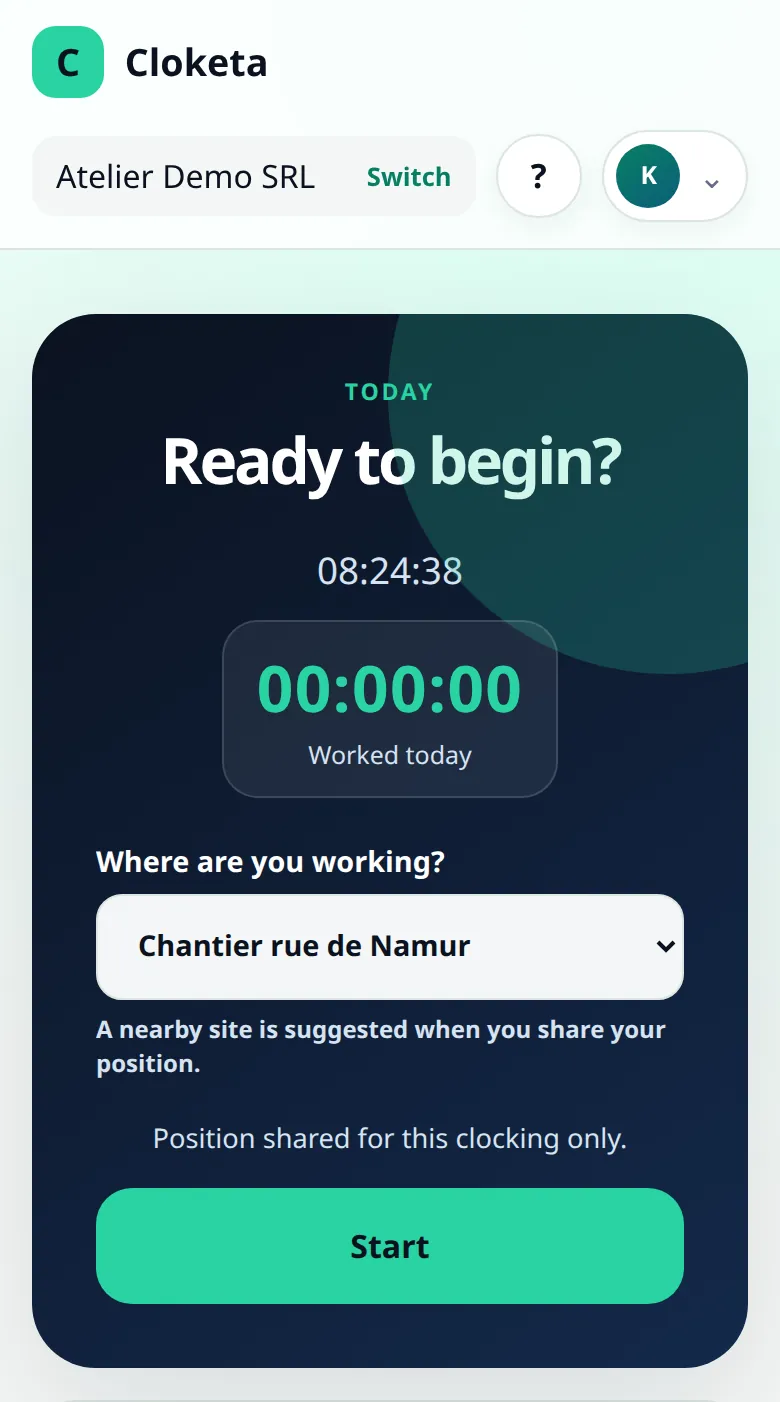
Karim opens Cloketa on his phone, chooses “Jambes site – renovation” under “Where are you working?” and taps “Start”.
- 10:00
He taps “Take a break”, then “Resume” at 10:15: two taps, 15 minutes deducted from his working time.
- 12:30
“Take a break” for lunch.
- 13:20
He selects “Wavre call-out” under “Where are you working?” and taps “Resume”: the new place is recorded with this clocking. In fact, he went back to work at 13:00 and forgot to clock in.
- 17:20
“Finish”: 10 h 15 min of attendance. Clocked breaks are deducted from working time.
- 17:40
In Reports, Karim chooses “Correct the day”, enters a restart at 13:00 with the reason “forgot to clock” and clicks “Send for approval”.
- 08:10, the next day
The manager sees the request, compares before and after, and accepts it. The day counts 45 minutes of break (15 + 30) and 9 h 30 min of work. The original time stays in the history.
Clocking from the site, with no time clock
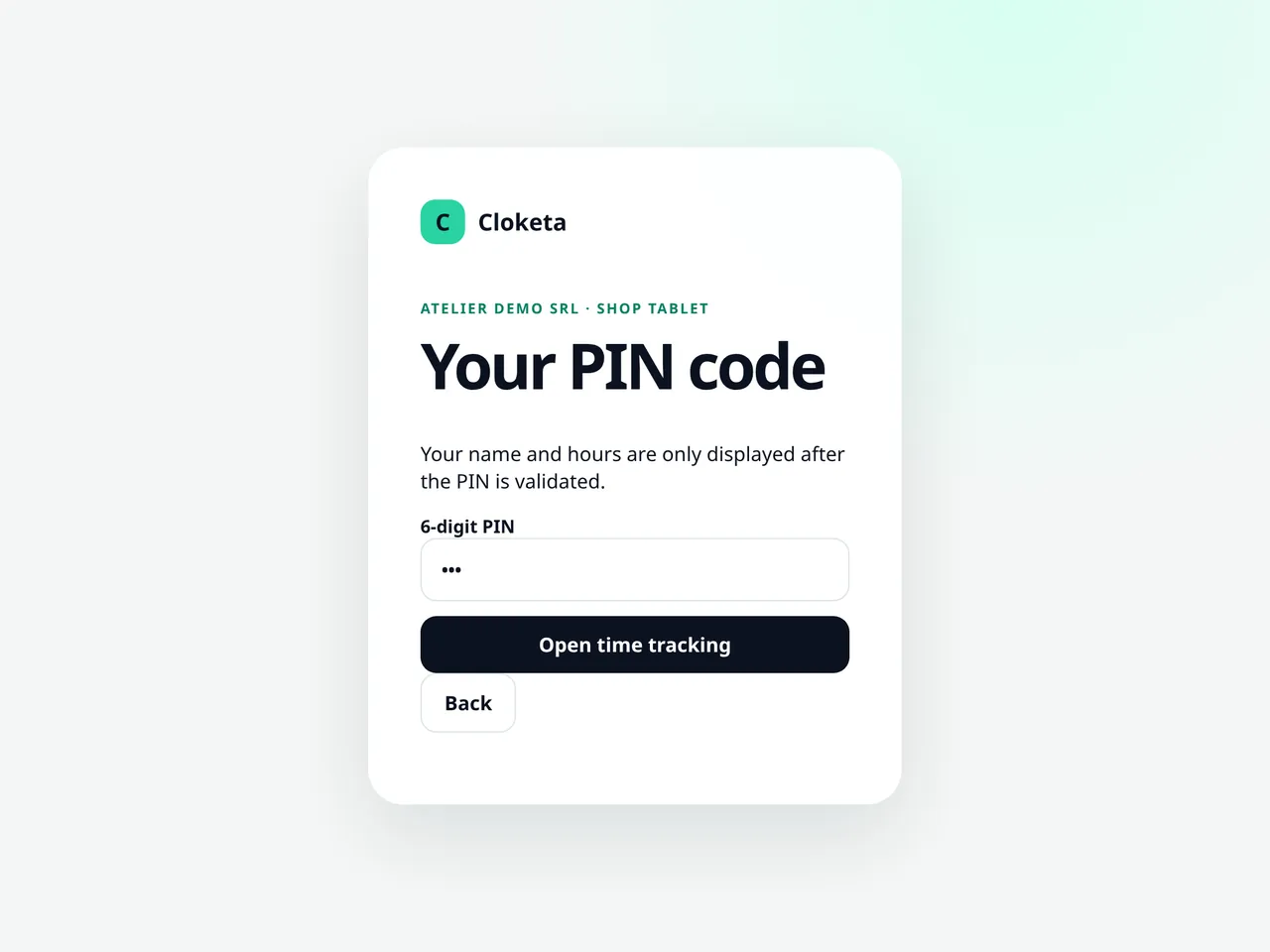
Your crews use their work phone. In a workshop or a garage, a clocking station (a tablet on the wall or at reception) lets everyone clock in by scanning their QR code (or entering their employee number), then typing their personal PIN code, including a labourer created without an email address. An internet connection is required: every clocking is validated immediately by the server.
Shared clocking stations are included in the Enterprise offer and available as an option in the other plans, at €4.90 excl. VAT per active station per month.
Workplaces, with or without geolocation
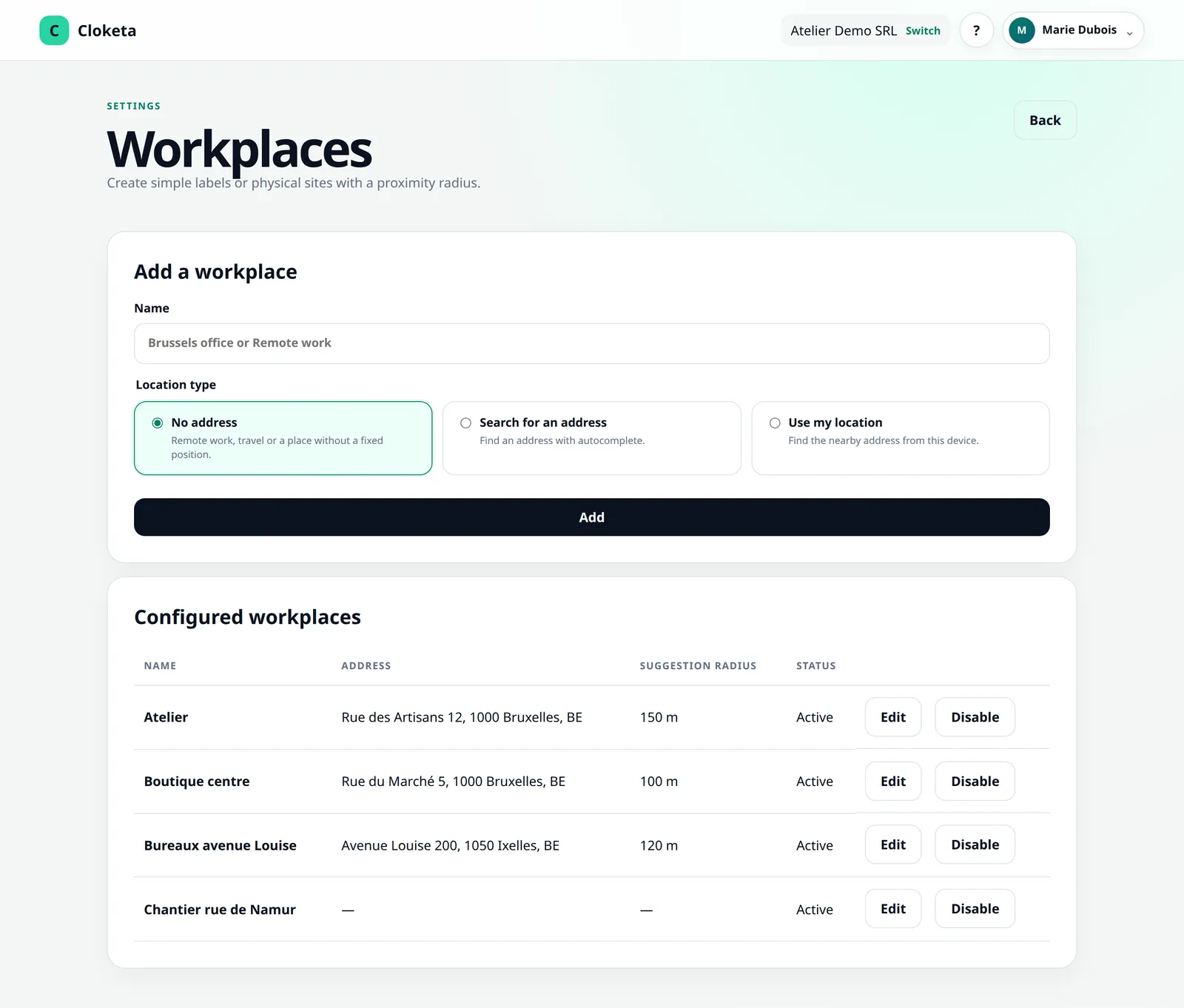
Create your building sites and premises as workplaces. The worker chooses their place under “Where are you working?”, and that place is recorded with every clocking (Start, Take a break, Resume, Finish). There is no “change place” button: a new site is recorded at the next clocking, for example when resuming after a break, or with “Finish” then “Start”. Do not clock a break to cover a journey: travelling between two sites during the day is in principle working time. If in doubt, ask your social secretariat.
Geolocation is off by default. You can make it optional or mandatory, and it is only captured at the moment of clocking, never during journeys. If you make it mandatory, a clocking without a position is refused. Inform your workers before you switch it on.
A clear view of who is where this morning
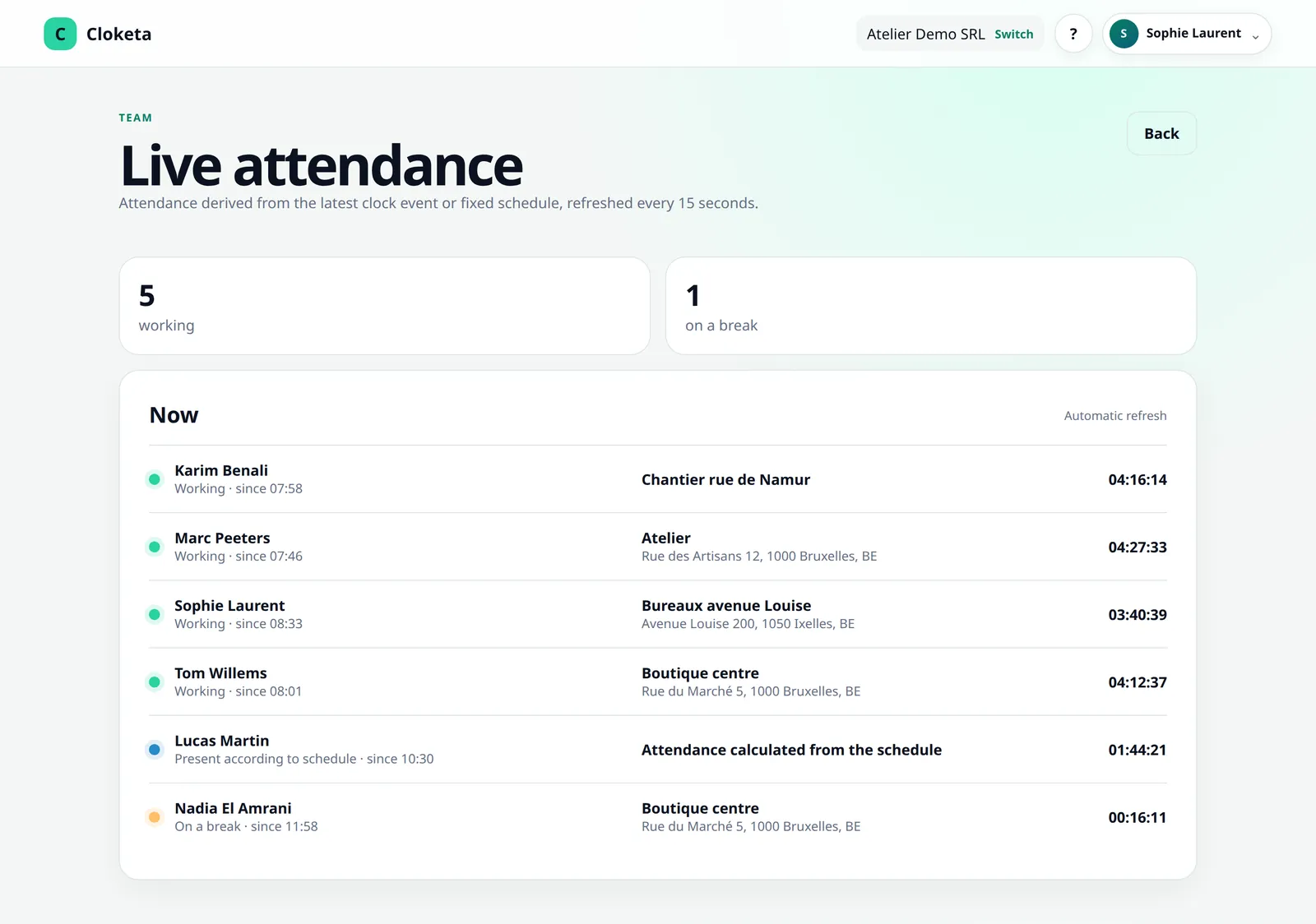
“Live attendance” shows you who is “Working” or “On a break”, with the name and address of the place of their last clocking. No more calling each crew to find out whether the site has started.
Create one team per site foreman, with sub-teams if needed. Each foreman approves their labourers' corrections. If a team has no lead, its requests go to the parent team, then to the administration. Teams and their managers are included in the Enterprise offer and available as an option in the other plans, at €0.50 excl. VAT per active worker per month.
Checkinatwork, Dimona and time recording: three different things
Checkinatwork: on sites with a total value of at least €500,000 excl. VAT, every person present must be registered each day in the NSSO's official application. A change has been announced, with a real-time check-in and check-out. According to published information, it would be postponed to 1 April 2027. These arrangements may still change.
Dimona: the immediate declaration of employment remains a separate formality, carried out by you or your social secretariat.
Working time recording: the general obligation announced for 2027 would cover the time actually worked by each worker. The preliminary draft bill mentions a possible exclusion of certain mobile workers, whose exact scope is not yet known.
Cloketa replaces neither Checkinatwork nor Dimona. It organises your internal hours: start, breaks, finish, corrections. Have your social secretariat confirm which workers are concerned and how to combine these records.
Checkinatwork on socialsecurity.be (opens in a new window)What has been announced for 2027
A crew of 6 on site? €199 excl. VAT per year.
With 6 active workers, you are on the Small plan (4 to 10 workers): €199 excl. VAT per year, or €19.90 excl. VAT per month. The essentials are included; shared clocking stations (€4.90 excl. VAT per active station per month), teams and leave (€0.50 excl. VAT per active worker per month each) are available as options. Invited people count from the moment they are invited. The manager or the person handling hours in the office does not count, unless they clock in themselves.
Frequently asked questions in the sector
Do I need to buy a time clock for every site?
No. Your workers clock in with their phone. For a workshop or a depot, a tablet used as a clocking station is enough: everyone scans their QR code (or types their employee number) on it, then their PIN code.
Do my labourers have to use their personal phone?
You cannot require it without a legal or contractual basis. Provide a work phone or a clocking station for those who do not wish to use their own device.
What happens if there is no signal on the site?
Clocking requires a connection: there is no offline mode. If you have made geolocation mandatory, a GPS position is also needed, otherwise the clocking is refused. In these cases, the worker corrects their day afterwards (“Correct the day”, with the right times and a reason), and the manager approves.
Does Cloketa replace Checkinatwork?
No. Checkinatwork is an official declaration to the NSSO. Cloketa records your internal working hours. The two coexist.
Can I see which site each person worked on?
Yes, if you create your sites as workplaces: the chosen place is recorded with every clocking, and it appears in the clocking details and in the exports. Cloketa does not calculate total hours per site, nor profitability or invoicing per site.
Is geolocation mandatory?
No. It is off by default. If you switch it on, it is only captured at the moment of clocking, and you must inform your workers beforehand.
Free trial
Try Cloketa on your next site
Create your workplaces, invite two labourers and follow a real week. By Friday, you will know whether you miss the timesheets.
Important information Cloketa is a working time recording tool. It does not provide legal or HR advice and does not replace any official declaration or application. Each employer remains responsible for their own obligations: if in doubt, consult your social secretariat or an adviser.